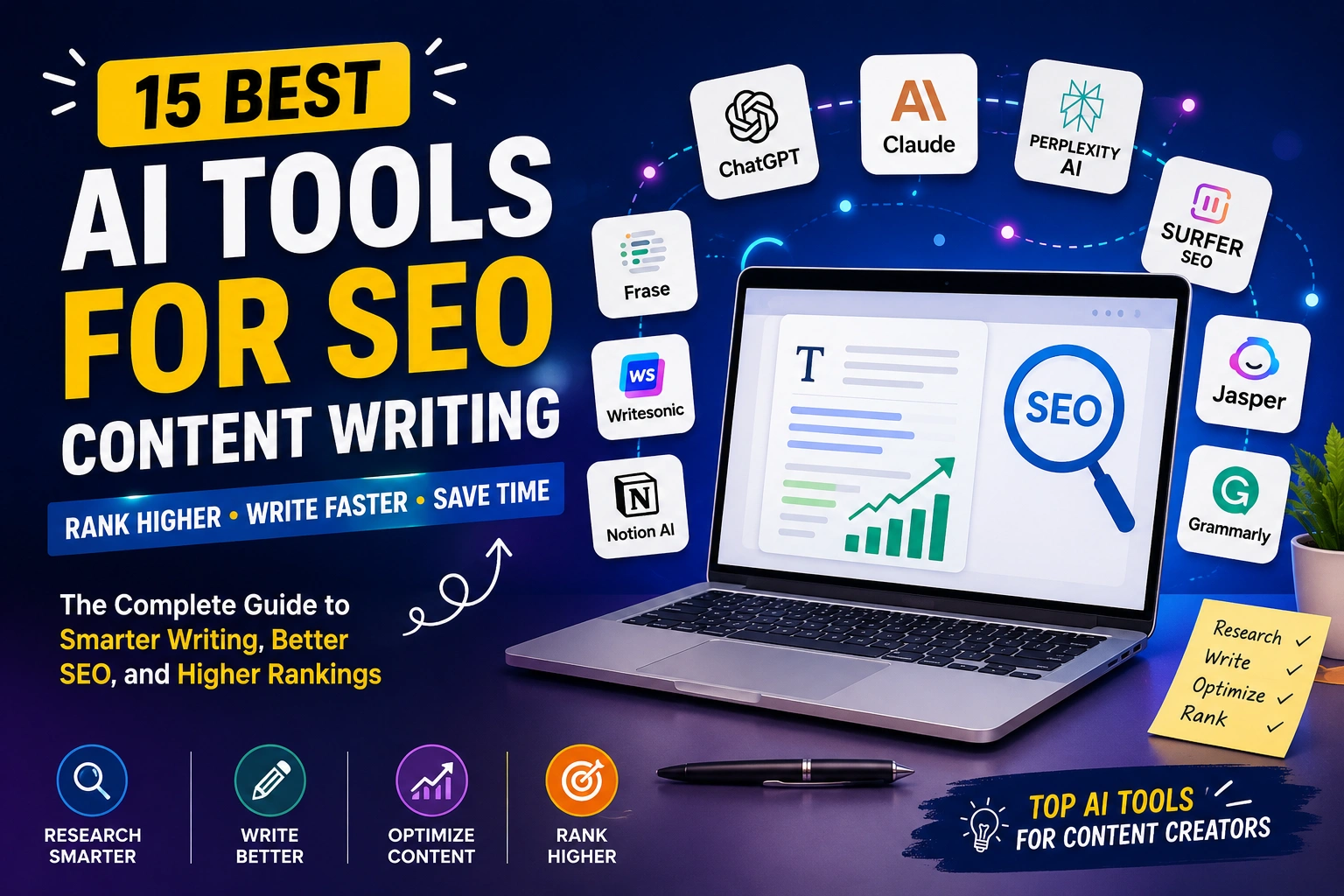
15 Best AI Tools for SEO Content Writing (Free & Paid)
Discover the 15 best AI tools for SEO content writing. Compare ChatGPT, Claude, Surfer SEO, Perplexity, Jasper, and more with real use cases, practical workflows, and expert recommendations.
Writing SEO content today is much more demanding than it was a few years ago.
Google no longer rewards articles simply because they contain the right keywords. Modern search engines evaluate whether your content satisfies search intent, answers real questions, demonstrates expertise, and provides a better experience than competing pages.
At the same time, content creators face increasing pressure to publish consistently. Bloggers, freelancers, agencies, and business owners often need to produce multiple articles every week while also researching keywords, optimizing content, editing drafts, designing images, and promoting their work.
This is exactly where AI has changed the content creation process.
Instead of replacing writers, AI removes repetitive work.
It can generate article ideas in seconds, organize outlines, summarize research, improve readability, suggest better headlines, fix grammar, and even identify gaps in your content. Tasks that once required several hours can now be completed much faster.
However, one mistake is becoming increasingly common.
Many beginners believe installing one AI tool is enough to create content that ranks on Google.
Unfortunately, that’s not how SEO works.
Professional content creators rarely depend on a single platform. Instead, they combine several tools, with each one solving a specific problem in the writing process.
For example, one tool may be excellent for brainstorming ideas, another may produce more natural writing, while a third specializes in optimizing articles for search engines.
Understanding these differences is far more valuable than simply choosing the most popular AI chatbot.
This guide doesn’t rank tools based on marketing claims.
Instead, it explains where each tool genuinely fits into an SEO workflow, where it performs well, where it struggles, and who should actually use it.
By the end of this guide, you’ll know exactly which AI tools deserve your time, which ones can safely be skipped, and how experienced SEO professionals combine them to create content that is both helpful for readers and optimized for search engines.
To get better results from AI writing tools, it’s important to understand how to give clear instructions. Our AI prompting guide explains the fundamentals of writing effective prompts.
Before You Choose an AI Writing Tool
Choosing an AI writing assistant isn’t the same as choosing a web browser or a note-taking app.
The “best” tool depends entirely on the problem you’re trying to solve.
Ask yourself a few simple questions.
Do you struggle with coming up with article ideas?
Do you spend too much time researching competitors?
Are your articles difficult to optimize?
Do you need help editing your writing?
Or are you simply looking for a faster way to produce high-quality blog posts?
Your answers will determine which AI tool deserves a place in your workflow.
Another important point is that no AI platform should become your only source of information.
Search engines reward content that demonstrates experience, accuracy, and originality.
The strongest articles combine AI assistance with human research, practical examples, and careful editing.
Think of AI as your assistant rather than your replacement.
That mindset alone will help you produce better content than many websites relying entirely on automated writing.
How We Evaluated These AI Tools
Rather than comparing tools based on advertising or popularity, we looked at how useful they are during the actual SEO writing process.
Each tool was evaluated using practical criteria such as:
- Writing quality
- Research capabilities
- SEO optimization features
- Ease of use
- Content planning
- Editing support
- Productivity improvements
- Value for money
Some tools scored highly because they create excellent first drafts.
Others earned their place because they dramatically reduce editing time or improve on-page optimization.
You’ll notice that not every recommendation is designed to write articles.
That’s intentional.
Successful SEO content depends on much more than writing alone.
My Recommended SEO Content Workflow
Before discussing individual tools, it’s helpful to understand how experienced content creators usually work.
Instead of asking one AI tool to generate an entire article, they divide the process into several stages.
| Stage | Goal |
| Topic Research | Discover what readers actually want |
| Keyword Planning | Choose the right search terms |
| Content Outline | Organize headings logically |
| First Draft | Build the article structure |
| Fact Checking | Verify important information |
| SEO Optimization | Improve headings and relevance |
| Editing | Improve clarity and grammar |
| Publishing | Add images, links, and metadata |
As you read this guide, notice where each AI tool fits into this workflow.
You’ll quickly realize that the best results usually come from combining two or three specialized tools rather than expecting one platform to do everything.
1. ChatGPT – The Foundation of a Modern SEO Workflow
If I had to build an SEO content workflow using only one AI tool, ChatGPT would still be my first choice.
Not because it’s perfect.
But because it’s incredibly flexible.
Most beginners think ChatGPT is only useful for writing articles.
In reality, article writing is just one small part of what it can do.
A typical SEO project often begins long before the first paragraph is written.
Imagine you’re planning an article targeting the keyword:
Best AI Tools for SEO Content Writing
Instead of asking ChatGPT to immediately generate a 3,000-word article, an experienced content creator would use it differently.
The first request might be to identify the search intent behind the keyword.
Once that becomes clear, the next step is generating several outline ideas.
After choosing the strongest outline, ChatGPT can help identify questions readers commonly ask, suggest logical heading structures, recommend internal linking opportunities, and even highlight areas where competing articles appear weak.
Only after this planning stage would the writing begin.
Breaking the process into smaller tasks produces far better content than requesting one massive article from the start.
Another reason ChatGPT remains so valuable is its adaptability.
If you’re writing for beginners, it can simplify technical concepts into plain English.
If you’re targeting professionals, it can expand discussions into greater detail.
That flexibility makes it useful for almost every type of website.
A Real Example
Suppose you’re updating an old blog post that has dropped from page one to page three in Google.
Instead of rewriting everything, you could ask ChatGPT to identify outdated sections, suggest additional subtopics, improve transitions between paragraphs, and recommend new FAQs based on user intent.
Within minutes, you have a practical improvement plan instead of guessing what needs to change.
Where ChatGPT Falls Short
Despite its strengths, ChatGPT isn’t a keyword research platform.
It doesn’t reliably provide search volume, keyword difficulty, or live SERP data.
For those tasks, you’ll still need dedicated SEO tools.
It also shouldn’t be trusted blindly for statistics or rapidly changing information without verification.
Who Should Use ChatGPT?
If you’re a blogger, freelancer, affiliate marketer, agency owner, or small business creating SEO content regularly, ChatGPT deserves to be the center of your workflow.
It’s especially valuable if you want one tool that supports planning, writing, editing, brainstorming, and content improvement without forcing you into a rigid template.
Expert Recommendation
The biggest improvement you can make isn’t buying another AI tool.
It’s learning how to ask better questions.
Detailed prompts consistently produce better content than generic instructions like:
“Write an SEO article.”
That’s why many experienced writers spend almost as much time planning prompts as they do editing the final article.
2. Claude – When Your Content Sounds Too Much Like AI
One of the easiest ways to recognize low-quality AI content is its writing style.
The sentences are often predictable.
Every paragraph has the same rhythm.
Transitions feel unnatural.
After reading a few sections, the article starts sounding repetitive, even if the information is correct.
This is where Claude stands out.
Instead of generating flashy marketing copy or trying to impress with complicated vocabulary, Claude focuses on writing that feels calm, natural, and human.
Many SEO writers don’t actually use Claude to create the first draft.
They use it to improve the draft they’ve already written.
Think of it as an editor rather than a writer.
A Practical Example
Let’s say you’ve written a 3,500-word article in ChatGPT.
Technically, everything is correct.
The headings are organized.
The keyword placement is natural.
But when you read the article, something feels off.
The paragraphs are too similar.
The tone becomes repetitive after a while.
Instead of rewriting everything manually, copy one section into Claude and ask it something like:
“Rewrite this section so it sounds more natural without changing the meaning. Keep the information accurate and avoid making it sound overly promotional.”
The difference is usually noticeable.
The information stays almost the same, but the writing flows much better.
Where Claude Fits in an SEO Workflow
Most people think AI writing is one step.
In reality, professional writers usually follow something like this:
Research
↓
Outline
↓
First Draft
↓
Human Editing
↓
Final Proofreading
Claude works best during the editing stage.
Instead of replacing your ideas, it helps express them more naturally.
This is especially useful if English isn’t your first language or if you often feel your writing sounds too formal.
ChatGPT vs Claude for SEO Writing
Both tools are excellent, but they solve different problems.
Imagine you’re explaining what internal linking is.
ChatGPT often gives a direct answer that’s easy to understand.
Claude usually expands the explanation with smoother transitions and a more conversational style.
Neither approach is automatically better.
If you’re creating tutorials or educational guides, many readers appreciate Claude’s natural tone.
If you’re brainstorming ideas quickly, ChatGPT is usually faster.
This is why many experienced bloggers use both instead of choosing only one.
When Claude May Not Be the Right Choice
Claude isn’t designed to replace dedicated SEO software.
It won’t tell you:
- Which keyword has the highest search volume.
- Which page currently ranks first.
- How difficult a keyword is.
- What your competitors are doing.
If your biggest challenge is keyword research, another tool should come first.
Claude becomes valuable after you’ve already completed your research.
Who Should Use Claude?
Claude is especially useful for:
- Bloggers writing long-form guides.
- Freelancers delivering articles to clients.
- Agencies that want consistent writing quality.
- Businesses publishing educational content.
- Anyone editing AI-generated drafts before publishing.
If your readers stay on the page because your articles are enjoyable to read, that’s a long-term advantage.
My Personal Recommendation
If I had both ChatGPT and Claude available, I wouldn’t replace one with the other.
I’d combine them.
I would use ChatGPT to plan the article, generate the outline, brainstorm ideas, and organize information.
Then I’d move the completed draft into Claude for the final writing polish.
That workflow usually produces stronger content than relying on a single platform from beginning to end.
For a deeper look at using ChatGPT throughout an SEO workflow, read our guide on How to Use ChatGPT for SEO.
3. Perplexity AI – The Research Assistant Every SEO Writer Needs
One of the biggest mistakes beginners make is asking ChatGPT questions that require current information.
For example:
“What are the latest Google ranking updates?”
or
“What are the newest AI SEO tools released this year?”
ChatGPT can provide useful explanations, but for topics that change frequently, you also need reliable and up-to-date sources.
This is exactly where Perplexity AI becomes valuable.
Unlike traditional AI chatbots that focus mainly on generating answers, Perplexity is designed to help you research before you write.
Instead of giving you only a response, it also points you toward supporting sources that you can review yourself.
That small difference completely changes how you should use the tool.
Imagine This Scenario
You’re writing an article titled:
Google Helpful Content Update Explained
Without a research assistant, your workflow might look like this:
Open Google.
- Visit ten different websites.
- Compare conflicting information.
- Copy notes into a document.
- Organize everything manually.
Now imagine doing the same task with Perplexity.
You ask a clear research question.
Within moments, you receive a structured summary along with links to supporting sources that you can verify.
Instead of spending an hour collecting information, you can begin understanding the topic almost immediately.
This doesn’t remove the need for fact-checking, but it dramatically speeds up the research phase.
Why This Matters for SEO
Strong SEO articles aren’t simply longer than competitors.
They’re usually better researched.
Readers trust articles that explain topics clearly, reference reliable information, and answer follow-up questions.
Research quality directly affects content quality.
Perplexity helps you build that foundation before you start writing.
A Workflow That Actually Works
Here’s a simple workflow many content creators can benefit from:
- Use Perplexity to understand the topic and gather reliable sources.
- Use ChatGPT to organize the information into a logical outline.
- Write the first draft.
- Improve readability with Claude.
- Perform a final grammar check using Grammarly.
Notice how every tool has a different job.
That’s the difference between using AI strategically and simply asking one chatbot to do everything.
When Perplexity Isn’t Necessary
If you’re writing about a topic you already know well, you may not need extensive AI-assisted research.
However, if you’re covering unfamiliar industries, recent developments, technical subjects, or software comparisons, Perplexity can save a significant amount of time while helping you build more accurate articles.
Who Should Use Perplexity?
Perplexity is an excellent choice for:
- Bloggers researching new topics.
- SEO writers creating in-depth guides.
- Affiliate marketers comparing products.
- Students learning unfamiliar subjects.
- Business owners writing educational content.
If research is the slowest part of your workflow, this is one of the first AI tools worth adding.
Expert Recommendation
Never copy research directly into your article.
Read it.
Understand it.
Then explain it in your own words while adding your own examples and insights.
That’s what separates helpful content from content that merely repeats information found elsewhere.

4. Surfer SEO – The Tool That Tells You What Your Article Is Missing
Many writers believe that once an article is finished, it’s ready to publish.
In reality, finishing the draft is only the halfway point.
The next challenge is making sure your content covers the topic well enough to compete with pages already ranking on Google.
This is where Surfer SEO becomes useful.
Unlike ChatGPT or Claude, Surfer SEO doesn’t try to be your writer.
Instead, it acts more like an SEO coach sitting beside you while you edit.
It analyzes your content against the pages currently ranking for your target keyword and highlights areas where your article may be incomplete.
That doesn’t mean you should blindly follow every suggestion, but it gives you a much clearer picture than guessing.
What Makes Surfer SEO Different?
Think of ChatGPT as someone helping you build a house.
Surfer SEO is the building inspector.
The house already exists.
Now someone checks whether anything important is missing.
That’s why experienced SEO writers often use Surfer after the first draft—not before.
A Real Editing Workflow
Here’s a practical example.
First draft:
- 2,400 words
- Good introduction
- Clear headings
- Useful examples
Looks finished.
After running it through Surfer SEO, you discover:
- Several important subtopics are missing.
- One section is much shorter than competitors.
- The article lacks answers to common user questions.
- Some headings could be more descriptive.
You improve those areas—not because the software says so, but because they genuinely make the article more useful.
That’s the right way to use SEO recommendations.
A Mistake Many Beginners Make
Some writers become obsessed with achieving the highest possible optimization score.
They start forcing keywords into every paragraph.
They repeat the same phrases unnaturally.
Eventually, the article becomes difficult to read.
Search engines have become much better at recognizing natural language.
An article written for humans usually performs better than one written only for a score.
Use Surfer SEO as a guide, not as a rulebook.
Is Surfer SEO Worth the Cost?
That depends on how often you publish.
If you write one blog post every few months, the investment may not make sense.
However, if you’re managing multiple websites, working with clients, or publishing content every week, the time saved during optimization can quickly justify the subscription.
Who Will Benefit Most?
Surfer SEO is ideal for:
- Affiliate marketers competing in competitive niches.
- SEO agencies managing several client websites.
- Businesses investing heavily in content marketing.
- Bloggers who regularly publish long-form articles.
If you’re serious about organic traffic, it’s one of the strongest optimization tools available.
My Recommendation
I don’t recommend opening Surfer SEO before you’ve written your article.
Write naturally first.
Explain the topic clearly.
Answer the reader’s questions.
Only then use Surfer SEO to identify genuine gaps that deserve improvement.
That workflow keeps your writing helpful while still benefiting from SEO analysis.
5. Frase – Start With the Right Questions Instead of the Right Keywords
Most people begin SEO by asking:
“What keyword should I target?”
Professional content strategists usually ask a different question:
“What does the searcher actually want to know?”
That small shift completely changes how an article is planned.
Frase is built around this idea.
Instead of encouraging you to chase keywords, it helps you understand search intent before you begin writing.
Why Search Intent Matters
Imagine two people searching almost identical phrases.
One types:
Best AI writing tools
Another searches:
How to choose an AI writing tool
The keywords are similar.
The intent is completely different.
The first person wants recommendations.
The second wants guidance before making a decision.
If you publish the wrong type of article, even excellent writing may struggle to rank because it doesn’t match what users expect.
How Frase Helps
Instead of opening dozens of browser tabs, Frase analyzes the pages already performing well for your keyword.
It identifies common questions, recurring themes, and topics that readers expect to see.
This doesn’t mean you should copy those articles.
Instead, you gain a clearer understanding of the conversation already happening around the topic.
That insight makes it much easier to create a useful outline before writing a single paragraph.
A Practical Example
Suppose you’re planning an article about:
Best AI Tools for Freelancers
Before writing, Frase reveals that high-ranking pages frequently answer questions such as:
- Which AI tools save the most time?
- Which tools have free plans?
- Are AI tools suitable for beginners?
- Which tools work best for writing, design, and client communication?
Without that research, it’s easy to overlook important questions.
By addressing them naturally, your article becomes more complete and more useful for readers.
Where Frase Fits Best
Think of your SEO workflow like this:
Research → Planning → Writing → Optimization → Editing
Frase belongs in the planning stage.
It helps you understand what should be included before you begin writing.
That often saves more time than trying to fix missing sections later.
My Recommendation
If ChatGPT is your writing assistant and Surfer SEO is your optimization assistant, Frase is your planning assistant.
Using all three together creates a much smoother workflow than relying on only one tool.
More importantly, it encourages you to think about readers first and keywords second—which is exactly the mindset modern SEO rewards.
6. Jasper AI – Built for Content That Converts, Not Just Ranks
Ranking on Google is only half the job.
After someone lands on your website, the next goal is keeping them engaged and encouraging them to take action. That action could be subscribing to your newsletter, downloading a guide, requesting a quote, or buying a product.
This is where Jasper AI has built its reputation.
Unlike ChatGPT, which is designed as a general-purpose AI assistant, Jasper was created with marketers in mind. Its biggest strength isn’t writing informational blog posts—it’s helping businesses create persuasive content that supports sales and conversions.
If your website earns money through affiliate marketing, SaaS products, eCommerce, or lead generation, Jasper deserves attention.
When Jasper Makes More Sense Than ChatGPT
Imagine you’ve already finished writing an article titled:
Best AI Tools for Small Business Owners
The article is informative, well-structured, and optimized for SEO.
Now you need to write:
- A compelling introduction.
- A product comparison section.
- Call-to-action buttons.
- Email signup copy.
- Landing page content.
While ChatGPT can certainly help, Jasper includes workflows specifically designed for these marketing tasks.
Instead of starting from scratch, you begin with templates that are already focused on conversion.
A Real Business Workflow
Consider a small software company launching a new AI tool.
Their content strategy might look like this:
- Research the topic with Perplexity AI.
- Create the blog article using ChatGPT.
- Optimize the article with Surfer SEO.
- Write the landing page using Jasper.
- Proofread everything with Grammarly.
Notice that Jasper enters the workflow after the educational content has already been created.
That’s because its real strength is turning readers into customers.
Should Bloggers Buy Jasper?
Not always.
If your main goal is publishing informational articles, ChatGPT often provides better value because it handles a wider variety of writing tasks.
However, if your website depends heavily on marketing copy, sales pages, or email campaigns, Jasper becomes much more attractive.
The decision depends on your business model rather than the tool itself.
My Recommendation
Don’t buy Jasper simply because it’s popular.
Buy it if your content strategy includes conversion-focused pages alongside SEO articles.
For bloggers just starting out, ChatGPT usually offers a better return on investment.
For marketing teams and businesses, Jasper can become a valuable addition to the workflow.
7. Grammarly – The Final Check Before You Hit Publish
One spelling mistake won’t destroy your rankings.
But dozens of small writing mistakes can slowly reduce your credibility.
Readers notice awkward sentences.
They notice inconsistent punctuation.
They notice confusing wording.
Most importantly, they notice when an article feels difficult to read.
That’s why Grammarly remains one of the simplest yet most valuable tools for SEO writers.
It doesn’t replace your writing.
It improves it.
The Last Five Minutes That Matter
Imagine you’ve just completed a 4,000-word article.
You’ve spent hours researching, writing, and optimizing.
At this point, many writers immediately publish.
Professional writers usually take one more step.
They review the article with Grammarly.
That final review often catches:
- Grammar mistakes.
- Misspelled words.
- Repeated phrases.
- Unclear sentences.
- Inconsistent punctuation.
Individually, these issues seem small.
Together, they create a much more polished reading experience.
A Simple Example
Original sentence:
ChatGPT help writers create article faster and improve SEO.
After editing:
ChatGPT helps writers create articles faster while improving their SEO workflow.
The second version communicates exactly the same idea, but it sounds more professional and is easier to read.
Multiply that improvement across an entire article, and the difference becomes significant.
Why Readability Matters for SEO
Google doesn’t rank content because it contains perfect grammar.
However, readers are more likely to stay on a page that’s easy to understand.
Longer engagement often leads to better user experience signals.
That’s one reason editing should never be skipped.
My Recommendation
Never rely entirely on AI-generated text.
Read every article yourself.
Then use Grammarly as your final quality check before publishing.
Think of it as the last editor in your publishing process rather than another writing assistant.
Beginners can also explore our collection of 100 best ChatGPT prompts for beginners to learn how to get more useful responses from AI.
8. Writesonic – When Speed Matters More Than Perfection
Not every writing project requires a 5,000-word expert guide.
Sometimes you simply need content quickly.
Perhaps you’re creating:
- Product descriptions.
- Category pages.
- Short blog posts.
- Social media captions.
- Landing page drafts.
Starting from an empty page every time can slow you down.
That’s where Writesonic becomes useful.
Its biggest advantage isn’t producing perfect content.
It’s helping you create a usable first draft within minutes.
Speed vs Quality
Imagine you manage an online store with hundreds of products.
Writing every product description manually would take weeks.
Using Writesonic, you can generate structured drafts quickly and then edit them to match your brand voice.
The same idea applies to SEO.
Instead of spending an hour writing a rough outline, you can generate one quickly and invest your time improving it.
The result is a more efficient workflow without sacrificing quality.
When Not to Use Writesonic
Writesonic works best as a starting point.
Publishing its first draft without editing is rarely a good idea.
Long-form SEO content still benefits from additional research, human editing, and optimization.
Think of Writesonic as a time-saving assistant rather than an automatic publishing machine.
My Recommendation
If your workload includes a large amount of repetitive writing, Writesonic can significantly increase productivity.
If your focus is creating detailed pillar articles, use it for brainstorming and drafting, then move to ChatGPT, Claude, or your preferred editor for refinement.
A Smarter Way to Combine These Tools
By this point, you may have noticed a pattern.
Successful content creators don’t search for the “best” AI tool.
They build a workflow where each tool has a clear responsibility.
For example:
| Stage | Recommended Tool |
| Research | Perplexity AI |
| Content Planning | Frase |
| First Draft | ChatGPT |
| Human Refinement | Claude |
| SEO Optimization | Surfer SEO |
| Marketing Copy | Jasper AI |
| Final Editing | Grammarly |
| Quick Drafts | Writesonic |
Instead of replacing one another, these tools complement each other.
That’s why experienced SEO professionals often achieve better results—not because they use more AI, but because they use the right AI tool at the right stage.

9. Notion AI – The Tool That Keeps Your Entire Content Strategy Organized
Most SEO problems aren’t caused by poor writing.
They’re caused by poor organization.
Ideas get saved in one app, keyword research is stored somewhere else, outlines are scattered across Google Docs, and publishing deadlines are forgotten.
Eventually, content production becomes inconsistent.
Notion AI solves a different problem than ChatGPT or Claude.
It isn’t trying to be the best writer.
It’s trying to become the workspace where your entire content strategy lives.
Imagine Managing 100 Articles
Suppose your goal is publishing two SEO articles every week.
Within a year, you’ll have more than 100 articles.
Now imagine keeping track of:
- Target keywords
- Search intent
- Publishing dates
- Internal links
- Update schedules
- Featured image status
- Ranking improvements
Trying to manage all of that in spreadsheets quickly becomes frustrating.
With Notion AI, everything stays in one place.
Instead of searching through dozens of folders, you can open a single dashboard and immediately see which articles are published, which are waiting for images, and which need updating.
Why Serious Bloggers Use It
One habit separates successful bloggers from beginners.
Beginners focus only on writing the next article.
Experienced bloggers think in systems.
They know which articles need updating, which topics should link together, and which keywords they’re targeting next month.
Notion AI makes that planning process much easier.
My Recommendation
If you’re only writing one article each month, Notion AI may feel unnecessary.
But once your website starts growing, organization becomes just as important as writing.
At that stage, Notion AI becomes one of the most valuable productivity tools you can add to your workflow.
10. Copy.ai – A Smart Choice for Short-Form Marketing Content
Not every piece of content is a blog post.
Sometimes you need:
- Meta descriptions
- Email subject lines
- Facebook ads
- Product descriptions
- LinkedIn posts
- Landing page headlines
These smaller writing tasks can take longer than expected because every sentence needs to grab attention.
That’s where Copy.ai performs well.
Rather than focusing on long-form SEO guides, it specializes in creating concise marketing copy.
Where It Fits Best
Imagine you’ve just finished writing a detailed article.
The article itself is complete.
Now you still need:
- An SEO title.
- A meta description.
- A LinkedIn post announcing the article.
- An email promoting the new content.
Instead of writing each one manually, Copy.ai can generate multiple variations within minutes.
You can then choose the version that best matches your audience.
Should Bloggers Buy It?
If your primary goal is writing long educational articles, probably not.
ChatGPT already handles many of these tasks effectively.
However, if content promotion is a major part of your marketing strategy, Copy.ai can save a considerable amount of time.
My Recommendation
Think of Copy.ai as a marketing assistant rather than an SEO writing assistant.
Its biggest strength begins after your article has already been published.
11. Google Gemini – A Better Choice for Google Workspace Users
Gemini often gets compared directly with ChatGPT.
While both are powerful AI assistants, they aren’t identical.
One of Gemini’s biggest advantages is how naturally it works with Google’s ecosystem.
If your daily workflow already includes:
- Google Docs
- Gmail
- Google Drive
- Google Sheets
Gemini fits into that environment with minimal friction.
Instead of constantly switching between applications, you can brainstorm ideas, summarize documents, and organize information while staying inside tools you already use.
Where Gemini Performs Well
Imagine you’re researching a topic inside Google Docs.
Instead of opening another application to summarize your notes, Gemini can help organize key points, suggest headings, and simplify complex information.
For writers who spend most of their day inside Google’s productivity tools, this creates a much smoother workflow.
Where ChatGPT Still Leads
For long-form blog writing, detailed prompting, and creative flexibility, many content creators still prefer ChatGPT.
That’s why you’ll often see professionals using both tools depending on the task.
My Recommendation
Don’t think of Gemini as a ChatGPT replacement.
Think of it as an excellent companion if Google’s ecosystem is already part of your daily workflow.
12. Rytr – A Good Starting Point for Beginners on a Budget
Not everyone can justify paying for several premium AI subscriptions.
If you’re just starting your blogging journey, your priorities should be simple:
- Learn SEO.
- Publish consistently.
- Improve your writing.
Rytr offers a budget-friendly way to experiment with AI writing before investing in more advanced platforms.
What It Does Well
Rytr is particularly useful for:
- Blog introductions
- Product descriptions
- Social media captions
- Short marketing copy
- Basic outlines
It isn’t designed to compete with ChatGPT for complex pillar articles, but it performs surprisingly well for smaller writing tasks.
Should You Upgrade Later?
Probably.
As your website grows, you’ll eventually need more advanced research, optimization, and editing capabilities.
At that point, tools like ChatGPT, Claude, or Surfer SEO become stronger long-term investments.
My Recommendation
Rytr is best viewed as a learning tool.
It’s affordable, beginner-friendly, and a practical way to understand how AI writing works before moving to more powerful platforms.
What If You Could Only Choose Three AI Tools?
Many beginners ask this question because subscribing to every platform isn’t realistic.
If I were starting a brand-new SEO website today, my toolkit would look like this:
Tool 1: ChatGPT
For brainstorming, outlining, drafting articles, generating FAQs, improving headings, and creating internal linking ideas.
Tool 2: Perplexity AI
For researching unfamiliar topics, verifying information, and understanding search intent before writing.
Tool 3: Grammarly
For polishing every article before publishing.
With just these three tools, you can create high-quality SEO content without feeling overwhelmed or spending money on software you may never fully use.
As your website grows, you can gradually introduce specialized tools like Surfer SEO, Frase, or Jasper where they solve a specific problem rather than simply adding another subscription.
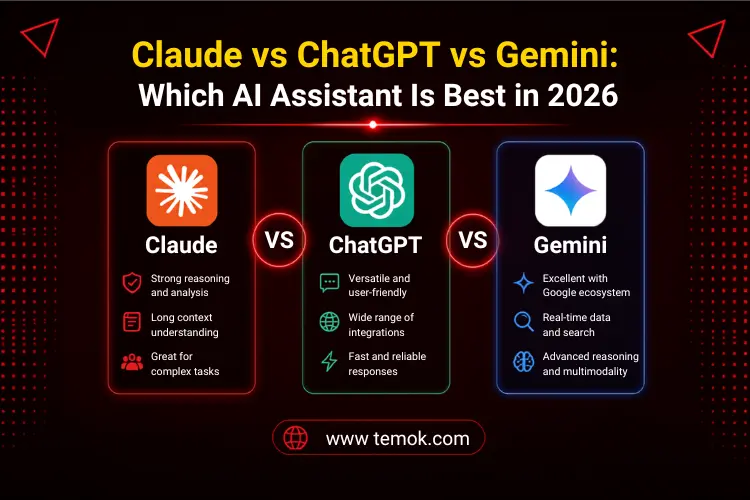
Not sure how Claude compares with other leading AI assistants? See our ChatGPT vs Gemini vs Claude comparison before choosing your primary writing tool.
Common AI Mistakes That Can Hurt Your SEO
AI can save hours of work, but using it the wrong way can create content that struggles to rank. Most SEO problems aren’t caused by AI itself—they’re caused by how people use it.
Here are some of the most common mistakes.
Publishing the First Draft Without Editing
One of the biggest misconceptions is that AI-generated content is ready to publish.
In reality, the first draft should be treated exactly as its name suggests—a draft.
Even the best AI tools can:
- Repeat ideas.
- Miss important context.
- Include outdated information.
- Write generic introductions.
- Overlook your audience’s specific needs.
Before publishing, read every section carefully. Add your own experience, improve weak explanations, and remove anything that doesn’t genuinely help the reader.
Depending on One Tool for Everything
Every AI platform has strengths and weaknesses.
For example:
- ChatGPT is excellent for drafting.
- Perplexity AI is stronger for research.
- Surfer SEO focuses on optimization.
- Grammarly improves readability.
Trying to force one tool to perform every task usually leads to average results.
A simple workflow with two or three well-chosen tools is often more effective than paying for ten subscriptions.
Forgetting Search Intent
Many writers focus so much on keywords that they forget why someone searched for them.
Imagine someone searches:
“How to use ChatGPT for SEO.”
They don’t want a history of artificial intelligence.
They want practical instructions they can follow today.
Before writing any article, ask yourself:
What problem is the reader trying to solve?
If every section moves the reader closer to solving that problem, you’re already on the right path.
Ignoring Human Experience
AI can explain concepts.
It can’t replace your personal experience.
If you’ve tested a tool, discovered a useful workflow, solved a difficult problem, or learned something through trial and error, include that insight in your article.
Those original observations are often what make content stand out.
A Simple SEO Workflow You Can Follow
If you’re feeling overwhelmed by the number of AI tools available, start with a simple process.
You don’t need expensive software or a complicated system.
Follow these steps instead.
Step 1: Find a Topic
Choose a topic people are actively searching for.
Use keyword research tools to identify questions your audience wants answered.
Step 2: Research the Topic
Use Perplexity AI or trusted sources to understand the subject.
Look for common questions, recent developments, and important details that readers expect to see.
Avoid relying on a single source.
Step 3: Create an Outline
Use ChatGPT to organize your ideas into a logical structure.
A clear outline makes the writing process much faster and helps prevent missing important sections.
Step 4: Write the First Draft
Focus on explaining the topic naturally.
Don’t worry about making every sentence perfect.
The goal is to communicate useful information clearly.
Step 5: Improve the Writing
Read the article carefully.
Use Claude or your own editing skills to improve flow, remove repetition, and make complex ideas easier to understand.
Step 6: Optimize for SEO
Review your article with an optimization tool like Surfer SEO if you have access to it.
Add relevant headings, answer common questions, and make sure the content fully addresses search intent.
Remember that optimization should improve the article—not make it sound unnatural.
Step 7: Proofread Before Publishing
Finally, review your article with Grammarly or another proofreading tool.
Correct grammar, improve clarity, and check that formatting is consistent throughout the page.
Only then should you publish.
Which AI Tool Is Right for You?
Choosing an AI tool becomes much easier when you think about your specific goals.
| If Your Goal Is… | Recommended Tool |
| Write complete blog posts | ChatGPT |
| Improve writing quality | Claude |
| Research topics faster | Perplexity AI |
| Optimize articles for SEO | Surfer SEO |
| Understand search intent | Frase |
| Write marketing copy | Jasper AI |
| Fix grammar and clarity | Grammarly |
| Organize your content strategy | Notion AI |
| Create short marketing copy | Copy.ai |
| Generate quick drafts | Writesonic |
| Work inside Google Workspace | Gemini |
| Start on a small budget | Rytr |
Notice that no single tool appears in every category.
That’s because successful SEO content is the result of a complete workflow—not one piece of software.
FAQs
What is the best AI tool for SEO content writing?
For most users, ChatGPT is the best all-around choice because it supports brainstorming, outlining, drafting, rewriting, and content planning. However, it works even better when combined with research and editing tools.
Can AI-written articles rank on Google?
Yes.
Google evaluates the quality and usefulness of content rather than whether AI was involved in creating it.
Articles that demonstrate originality, accuracy, and genuine value have a much better chance of performing well than content published without editing or research.
Should beginners pay for expensive SEO tools?
Not immediately.
Many beginners can produce excellent content using a combination of ChatGPT, Perplexity AI, and Grammarly.
As your website grows, you can decide whether advanced tools like Surfer SEO or Frase provide enough value for your workflow.
Is using multiple AI tools better than using one?
In many cases, yes.
Different tools specialize in different tasks.
Combining research, writing, optimization, and editing tools often produces stronger content than relying on a single AI assistant.
How often should I update SEO articles?
Review important articles every few months or whenever significant changes occur in your topic.
Updating outdated information, improving examples, and answering new user questions can help maintain long-term value.