AI Prompting Guide: 8 Ways to Write Better Prompts in 2026
This practical AI prompting guide shows how to write better prompts for ChatGPT, Gemini, and Claude using simple formulas, examples, and smart techniques.
AI Prompting Guide: Stop Getting Boring Answers from AI
You open ChatGPT and type:
“Write me a blog.”
A few seconds later, AI gives you an article that sounds like it was written by a tired robot during its lunch break.
The introduction is boring.
The ideas are repeated.
The conclusion says, “In today’s digital world.”
You look at the screen and think:
“Is this really the future of artificial intelligence?”
Yes, AI can produce weak content. But most of the time, the real problem is not the AI.
The problem is the prompt.
Think of AI as a very fast employee who knows a lot but understands nothing about your project until you explain it.
Give it a lazy instruction, and you will get a lazy answer.
Give it a clear brief, and suddenly it can write, organize, compare, brainstorm, plan, and explain ideas in a surprisingly useful way.
This AI prompting guide will show you how to stop giving AI vague instructions and start getting responses you can actually use.
If you are new to AI, start by learning how to use ChatGPT for beginners before mastering advanced prompting techniques.
What is AI Prompting
AI prompting means giving instructions to an artificial intelligence tool.
That instruction can be:
- A question
- A command
- A detailed brief
- An example
- A document
- An image
- A follow-up request
For example:
Weak prompt:
“Write about fitness.”
AI now has to guess everything.
Does the user want gym fitness, home workouts, weight loss, bodybuilding, or fitness for older adults?
Now look at this:
Better prompt:
“Write a beginner-friendly blog about home workouts for busy office workers. Include five exercises that require no equipment. Use simple language, short paragraphs, and practical tips.”
The second prompt gives AI a road map.
It explains the topic, audience, format, tone, and purpose.
That is the difference between random output and useful output.
AI is Not a Mind Reader
Imagine hiring a chef and saying:
“Make me something good.”
The chief may bring pasta.
You wanted pizza.
That does not mean the chef is bad. It means your instruction was unclear.
AI works similarly.
When you say:
“Make this better.”
AI does not know whether you mean:
- Make it shorter
- Make it more professional
- Make it funnier
- Improve the grammar
- Add examples
- Change the tone
- Make it more persuasive
A better instruction would be:
“Rewrite this introduction using a conversational tone. Start with a surprising question, use shorter sentences, and remove repeated ideas.”
Now AI knows what “better” actually means.
The Golden Rule of AI Prompting
Here is the most important rule in this entire guide:
Do not make AI guess what you want.
Every important guess creates another chance for a bad response.
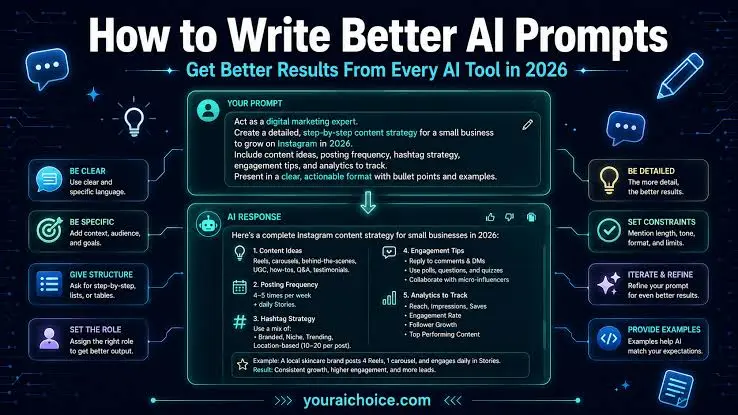
Before sending a prompt, explain:
- What you want
- Who it is for
- Why you need it
- What it should include
- What it should avoid
- How it should be presented
You do not need to write a 500-word prompt every time.
You only need to provide the details that matter.
Use the BRIEF Prompt Formula
A good prompt should work like a creative brief.
Use this simple formula:
B: Background
Give the AI enough information to understand the situation.
Example:
“I run a small handmade candle shop on Etsy.”
R: Role
Tell the AI what type of expert or assistant it should act as.
Example:
“Act as an experienced Etsy copywriter.”
I: Instruction
Clearly explain the task.
Example:
“Write a product description for a lavender candle.”
E: Expectations
Describe the tone, audience, limits, and important requirements.
Example:
“Write for women interested in relaxation and home decor. Use warm language, short paragraphs, and avoid exaggerated claims.”
F: Format
Tell AI how to organize the answer.
Example:
“Include a short opening, product benefits, what is included, and a final call to action.”
Put everything together, and you get:
“Act as an experienced Etsy copywriter. I run a handmade candle shop. Write a product description for a lavender candle aimed at women interested in relaxation and home decor. Use warm, natural language and short paragraphs. Avoid exaggerated claims. Include a short opening, key benefits, product details, and a gentle call to action. “
That prompt is not complicated.
It is simply clear.
Bad Prompts vs Better Prompts
Let us look at a few real examples.
Example 1: Blog Writing
Bad prompt:
“Write an SEO article.”
Better prompt:
“Write a 1,200-word SEO article about reducing electricity bills at home. The audience includes homeowners in the United States. Use simple English, practical examples, clear headings, and short paragraphs. Include seven tips and 5 FAQs.”
Example 2: Social Media
Bad prompt:
“Give me Instagram ideas.”
Better prompt:
“Create Instagram post ideas for a local bakery. Focus on fresh products, behind-the-scenes content, customer stories, and seasonal offers. Present the ideas in a table with a post topic, caption angle, and call to action.”
Example 3: Email Writing
Bad prompt:
“Write an email to my client.”
Better prompt:
“Write a polite follow-up email to a client who received my proposal seven days ago. Keep it professional and friendly. Do not sound desperate or pushy. Keep the email under 120 words.”
Example 4: Learning
Bad prompt:
“Explain SEO.”
Better prompt:
“Explain SEO to a 13-year-old student using a simple shop example. Avoid technical language and divide the explanation into five short sections.”
The better prompts are not magical.
They simply remove confusion.
Using the right prompts becomes even more powerful when combined with the best AI tools for content creators.
Why Most AI Content Sounds Boring
A lot of AI-written content sounds boring because people ask for content in boring ways.
For example:
“Write a professional article about digital marketing.”
This prompt practically invites AI to write generic lines such as:
“In today’s fast-paced digital landscape, businesses must leverage innovative strategies.”
Nobody talks like that.
If you want natural content, your prompt should request natural content.
Try this:
“Write like an experienced marketer talking to a small business owner over coffee. Use simple words, real examples, and direct advice. Avoid corporate phrases, filler, and exaggerated claims.”
That one instruction can completely change the tone.
Tell AI What to Avoid
Most people tell AI what to include.
Smart users also tell it what to avoid.
You can add instructions such as:
- Do not use robotic phrases
- Avoid long instructions
- Do not repeat the same idea
- Avoid keyword stuffing
- Do not invent statistics
- Do not use difficult words
- Avoid exaggerated claims
- Do not add information outside the provided source
Example:
“Write a friendly product description. Avoid words such as revolutionary, game-changing, ultimate, and perfect.”
This helps AI stay closer to your preferred style.
Use Examples to Teach AI Your Style
Sometimes explaining your preferred style is difficult.
Showing an example is easier.
Suppose you want short, punchy headlines.
You could write:
“Create five headlines using the same style as these examples:
Save Money Without Giving Up Coffee.
Your Website is Losing Customers
Stop Making These Email Mistakes
Now create five headlines about AI prompting.”
The AI can study the pattern and create similar headlines without copying them.
This method is called example-based prompting or few-shot prompting.
It is extremely useful for:
- Product descriptions
- Social media captions
- Headlines
- Emails
- Brand voice
- Content formatting
Do Not Ask AI to Do Everything At Once
Here is another common mistake:
“Research my audience, analyze competitors, create a strategy, write a blog, design social posts, and make an email campaign.”
That is not a prompt.
That is an entire marketing department.
Break large tasks into stages.
For example:
Prompt 1
“Identify the main problems faced by first-time Etsy sellers.”
Prompt 2
“Turn those problems into ten blog topics.”
Prompt 3
“Create an outline for topic number three.”
Prompt 4
“Write the introduction using a friendly and encouraging tone.”
Prompt 5
“Review the article for repetition and unclear sentences.”
This is called prompt chaining.
It gives you more control and usually produces better results.
Your First AI Answer Is Not the Final Answer
Many people type one prompt, read the response, and give up.
That is like asking a designer for the first draft and publishing it without feedback.
AI works better when you continue the conversation.
Useful follow-up prompts include:
- Make the opening more interesting
- Add a real-life example
- Remove repeated information
- Rewrite this for beginners
- Make the tone warmer
- Turn this section into a table
- Add stronger subheadings
- Shorten each paragraph
- Explain this point more clearly
- Give me three alternative versions
The first response is often raw material.
Your follow-up prompts shape it into something useful.
Freelancers and creators who want to make money with AI often get better results by providing detailed context in their prompts.
A Simple Trick for Better AI Answers
Before asking AI to complete a task, ask it to identify what information it needs.
Example:
“I want you to create a marketing plan for my business. Before writing the plan, list the information you need from me.”
AI may ask about:
- Your product
- Target audience
- Budget
- Location
- Competitors
- Marketing channels
- Main business goal
Once you provide those answers, the final strategy becomes far more relevant.
This technique is useful when you are unsure what details to include in your prompt.
Ask AI to Critique Its Own Work
AI can review its own response before giving you the final version.
Add this instruction:
“Before finishing, review the answer for clarity, repetition, missing information, and unsupported claims.”
You can also ask:
“Rate this response from 1 to 10 for clarity, usefulness, and accuracy. Then improve the weakest areas.”
This will not make the answer perfect, but it can catch obvious problems.
How to Reduce AI Hallucinations
AI sometimes presents incorrect information with surprising confidence.
This is called an AI Hallucination.
It may invent:
- Statistics
- Studies
- Quotes
- Dates
- Sources
- Product features
- Laws or policies
To reduce this risk, use instructions such as:
“Use only the information in the attached document.”
“Do not invent facts or statistics.”
“Clearly label assumptions.”
“If information is missing, say you do not have enough information.”
“Provide sources for claims that may need verification.”
Even with these instructions, important facts should still be checked.
Never blindly trust AI-generated legal, medical, financial, or safety information.

AI Prompt Examples You Can Copy
Blog Writing Prompt
“Act as an experienced content writer. Write a 1,500-word beginner-friendly article about starting an online business. Use a conversational tone, short paragraphs, real examples, and practical tips. Avoid filler and repeated ideas. Include a checklist and five FAQs.”
Product Description Prompt
“Write an Etsy product description for a printable wedding planner. The target buyer is a bride planning her own wedding. Use warm, clear language. Explain what is included, how the digital download works, and how the planner saves time. Avoid keyword stuffing.”
Social Media Prompt
“Create seven Instagram captions for a handmade soap brand. Use a friendly and natural tone. Each caption should focus on one customer benefit and end with a simple call to action. Avoid exaggerated claims.”
Email Prompt
“Write a professional but friendly email asking a client to approve the final design. Keep it under 150 words. Mention that work will continue after approval. Do not sound demanding.”
Study Prompt
“Explain the water cycle to a seventh-grade student using a simple story. Define evaporation, condensation, and precipitation. End with five quiz questions.”
Content Improvement Prompt
“Rewrite the article below to make it more engaging. Start with the reader’s main problem, use shorter paragraphs, add practical examples, and remove robotic phrases. Keep the facts and original meaning unchanged.”
Quick AI Prompting Checklist
Before sending a prompt, ask yourself:
- Is my task clear?
- Did I mention the audience?
- Did I provide enough background?
- Did I explain the desired tone?
- Did I include important limits?
- Did I request a useful format?
- Did I tell AI what to avoid?
- Should I provide an example?
- Will I verify important claims?
If your answer is yes to most of these questions, your prompt is probably ready.
Keep practicing these prompting techniques and explore more beginner AI guides to improve your AI skills faster.
FAQs
What is AI prompting?
AI prompting is the process of giving instructions, examples, questions, or information to an artificial intelligence tool.
How do I write a good AI prompt?
Clearly explain the task, audience, context, requirements, tone, and desired response format.
Do longer prompts always produce better answers?
No. A longer prompt can still be confusing. Clear and relevant instructions matter more than length.
What is prompt engineering?
Prompt engineering is the process of designing, testing, and improving prompts to produce more useful and consistent AI responses.
Can I use the same prompt with ChatGPT, Gemini, and Claude?
Yes, but the results may differ. Each AI model may respond better to slightly different instructions.
Why does AI repeat information?
AI may repeat ideas when the task is broad, the requested length is too long, or the prompt does not tell it to avoid repetition.
Can AI-generated content be published directly?
It should be reviewed first. Check facts, improve originality, remove repetition, and add your own experience or examples.
How can I make AI content sound human?
Ask for natural language, varied sentence lengths, real examples, direct advice, and short paragraphs. Remove robotic phrases during editing.
Final Thoughts
AI prompt is not about discovering a secret command that unlocks perfect answers.
It is about giving a better brief.
The next time AI gives you a boring response, do not immediately blame the tool.
Look at your prompt.
Use the BRIEF formula:
Background, Role, Instruction, Expectations, and Format.
Then review the result and improve it with follow-up prompts.
AI may be fast, but you are still the director.
The quality of the final result depends on how clearly you guide it.